
Meagan Drillinger
The bus rolled into Merida about 6:30 p.m. on a Wednesday. I had spent the last two weeks in Playa del Carmen (I had planned on two days). I knew nothing about where I was going, except for the fact that I knew I had always wanted to go there.
Once again the siren call of Mexico's cities proved stronger than my itinerary, and what was meant to be a two-day stint quickly turned into five, because when you finally discover Merida you won't ever want to leave.
Merida is the capital of Yucatan state. Built on the site of the ancient Mayan city T'ho, it was founded by Francisco de Montejo in 1542 and took its name from a town in western Spain. What used to be the epicenter of Mayan culture was quickly destroyed, including the city's five main pyramids, which were used to construct the important buildings of the Spanish settlers. Merida has the second largest historical city center in Mexico, after Mexico City.
What to do
The main artery of Merida's Centro is Calle 60, a long, straight road that sails past the major historical sites of the city, from the Plaza de Independencia, with its St. Ildephonsus Cathedral and Government Palace, to the smaller Parque de Santa Lucia, with its live, traditional music every Thursday night.
On Sundays, Calle 60 is closed off to car traffic and becomes entirely pedestrian- and bike-friendly -- perfect for meandering among the brightly colored, colonial buildings that are so evocative of colonial Mexico. On Friday nights and Sunday afternoons, the Yucatan Symphony Orchestra puts on performances at the Teatro Jose Peon Contreras, also on Calle 60.
Beyond exploring the cultural sites, Merida is a great home base for exploring the nearby communities.
A day trip to Uxmal is an absolute must. Uxmal is an archaeological site located in the Puuc region, about 48 miles from Merida, and is one of the few sites that visitors are still able to climb.
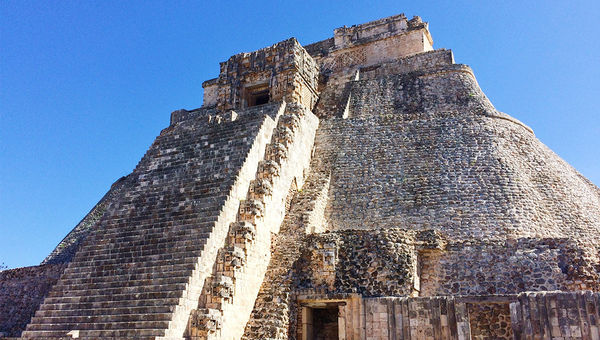
The Pyramid of the Magician at Uxmal. Photo Credit: Meagan Drillinger
Uxmal is home to the Pyramid of the Magician, the tallest structure standing, at 100 feet, which, according to myth, was built by the god Itzamna in one night. Archaeologists said it was built in five phases and is situated so that its western stairway faces the setting sun at the summer solstice.
Visitors can still climb a few of the structures in Uxmal, primarily on the north side of the ruins, allowing views of the forest and structures in the background such as the Gran Piramide, Casa de las Tortugas, la Plataforma de los Jaguares, la Casa de las Palomas and the ball court.
Many of the hotels in the area offer tour packages to Uxmal, which cost about $24 and include lunch. It should be noted that the admission to the actual park is not included, which is about $9.
Another fantastic day trip from Merida is a visit to Celestun, a laid-back, sleepy fisherman beach town on the north coast of the Yucatan. The sun-drenched streets lead to a lazy lifestyle, which is just how the locals want it. Daily boats run off the coast to take tourists to see the groves of pelicans that are just off shore. Camp out at Los Pampanos, a beach restaurant with tremendous ceviche, cheap drinks and freshly caught-and-grilled fish. A trip to Celestun can be made by local bus for about $3, but the journey is about 2.5 hours. An Uber costs roughly $30 and makes the trip in an hour and a half.
Where to eat
It is entirely possible to come to Merida and spend the day eating (as my waistline has unfortunately discovered).
My first plan of action was to Google the best breakfast in Merida. Fortunately for me, one of the top recommended places was right around the corner from my hostel, and it became a fast favorite. In fact, my breakfast here my first morning was the impetus for extending my trip an additional few nights.
El Barrio Comfort Food is a charming hole-in-the-wall restaurant tucked into a corner colonial building right on the edge of Centro. The proprietor makes all of her food organically and to-order. The yellow walls are decked with local art, and a small shelf totes local books, coffee and jarred treats.
My top breakfast recommendations are the huevos divorciados (eggs on tortillas, bathed in green and red salsa), the huevos encamisados (two eggs in a puffed tortilla, blanketed in salsa, with beans, fried plantains, and smoked meat), or, my personal favorite, pavo enmolada (shredded turkey in mole sauce on top of a tortilla with fried plantains and queso fresco).
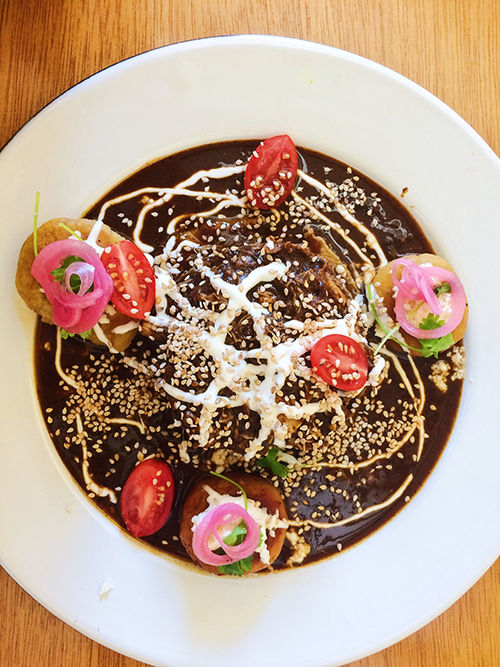
Pavo enmolada at El Barrio Comfort Food. Photo Credit: Meagan Drillinger
For a casual but elegant lunch, head to Apoala on Parque Santa Lucia. The gorgeous restaurant has al fresco seating and a menu of beautiful mezcal cocktails, alongside Yucatecan favorites like cochinita pibil, ceviches, salads, and other pork and fish. Opt for the octopus and scallop ceviche.
Mercado de Santiago is the major local market that sells handicrafts and other goods, as well as a plethora of local foods. For the best cochinita pibil tacos, visit this market.
For dinner visit Mercado 60, an outdoor food court held in an old parking lot with live music, strings of Edison bulbs, and a variety of food stalls selling everything from Spanish tapas, to barbecue to Yucatecan favorites, to pizzas. Grab a glass of wine or cold beer and sit at one of the many long benches to make new friends and enjoy the warm Merida air.
At night the locals flock to La Negrita, a small corner cantina with live salsa music, a menu of local favorites, and strong mezcal and tequila cocktails. The bar closes at 10, after which everyone moves to the Mezcaleria bar.