Airport lounges, once mostly the provenance of corporate and premium travelers, have opened to the masses in recent years, fueled by inexpensive day passes and the proliferation of flyers who obtain access through credit cards.
And as that access translates to larger crowds, independent lounge networks are increasingly turning to segmentation in an effort to provide extra luxury and privacy to their most elite and wealthy clients.
"Everyone recognizes that high-value customers need to have a separate experience," said Janis Tse, CEO of Lounges by Yates, a Hong Kong-based lounge design and consulting company.
One example is Priority Pass, the world's largest independent airport lounge access program, which introduced Priority Pass Private in September, an end-to-end airport experience that utilizes private terminals and exclusive lounges that aren't part of standard Priority Pass offerings.
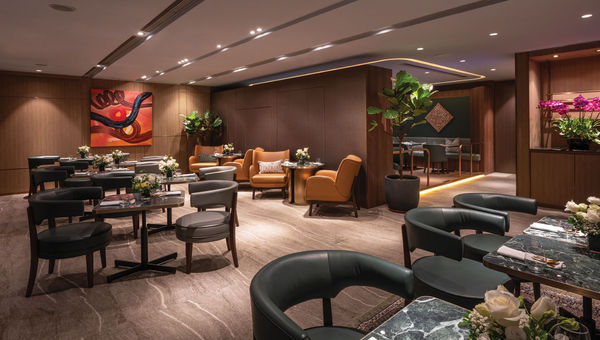
The Infinity Room at the Plaza Premium First lounge in Hong Kong. Photo Credit: Plaza Premium
Christopher Ross, chief brand officer for Priority Pass owner Collinson Group, said that statistics show that the percentage of high and ultrahigh-net-worth people globally is growing.
"Some of the sums that are forecast around generational wealth are also quite staggering," he said, adding that with more "rich and very rich people in the world, what we see from our clients, who are banks and credit card companies and wealth management companies, is a desire to have a product that is more suited to this sector of the market."
Collinson's lounge development subsidiary, Airport Dimensions, is also in on the act. Its fourth Clubrooms lounge, an elevated concept which requires Priority Pass members to pay an up-charge, opened this year at London Heathrow. Meanwhile, Plaza Premium, the world's largest independent lounge developer, is growing its network of Plaza Premium First lounges, which offer more service, personal space and amenities at a higher price than regular Plaza Premium lounges.
There are three Plaza Premium First lounges in the works to augment the six existing ones, including a first in the U.S., set to open at New York JFK's new Terminal 1 in 2026. JFK Plaza Premium First will also have a lounge within a lounge, called Infinity Room, reserved for first- and business-class flyers on partner airlines. A la carte dining, a facility introduction by an ambassador after check-in and complimentary massages are among the offerings in First lounges, said Plaza Premium Group chief commercial officer Jonathan Song.
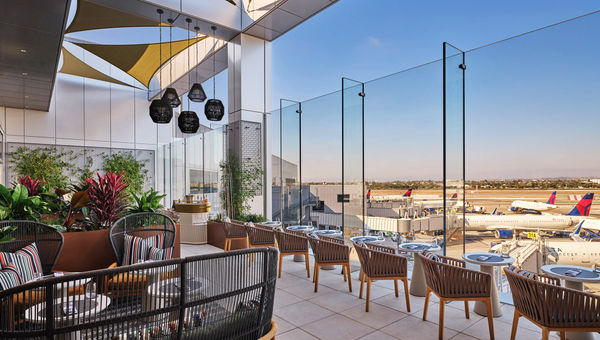
The Delta One lounge's terrace at Los Angeles International Airport. Photo Credit: Delta
Segmentation, of course, isn't new in the airline lounge business, especially within those owned by airlines. Among the U.S. Big 3 carriers, United operates Polaris lounges for business-class international flyers alongside its broader network of easier-to-access United Clubs. American is similar, with Flagship lounges that co-exist with more accessible Admirals Clubs. And Delta, long a holdout, joined the party last year with its first Delta One premium lounges joining its Sky Club brand.
Independent lounges, however, have largely served to democratize the airline lounge business, offering affordable day passes and memberships to travelers of various types, regardless of the carrier they are flying that day. One-time entry can often costs $50 or less. The lowest annual membership fee for Priority Pass, for those who don't get it through a credit card, is just $99.
The less well-heeled market segment is still crucial to those independent operators, driving robust growth. Through September, Priority Pass had seen 13% year-over-year growth in visits across its more than 1,700 global lounges while growing its network by 6%, the company said. Since 2022, visitation in the network is up close to 160%.
But burgeoning numbers bring increased challenges in managing capacity.
The Club brand of lounges operated by Airport Dimensions is addressing that problem through advanced reservations, digital waitlists and close monitoring of usage patterns, said senior vice president of global business development Chris Gwilliam.
Expansion is another antidote, but airport real estate is often tight.
"Sometimes the airports just don't have available space," Gwilliam said. "It's a problem in the industry."
The Infinity Room at the Plaza Premium First lounge in Hong Kong. Photo Credit: Plaza Premium
To serve the growing marketplace of travelers who expect more space and privacy and are willing to pay for it, segmentation will accelerate, Tse said. Expect more private access points, differentiated services, lounge-in-lounge spaces and concierge services tailored for the highest value clients, she said.
That is the direction Priority Pass Private is leaning into. The network launched with 76 airports globally, including Los Angeles and Atlanta. But these aren't new lounges. Rather, Priority Pass partnered with existing facilities, often located in discreet, private areas of airports, Ross said. The service begins at airport arrival, often in private terminals, where check-in and security are expedited. Priority Pass is offering the private service only through business-to-business transactions with select banks, financial institutions and wealth management companies.
To maintain privacy, Ross declined to detail the lounges with which Priority Pass Private has partnered in its U.S. locations. A likely candidate, however, is PS Lounges, whose two U.S. facilities are housed in private terminals in Los Angeles and Atlanta, providing TSA and customs clearance and private transfers directly to the airfield.
"It's the closest thing to private travel on a commercial plane," Ross said.