Having just left a company whose revenue quadrupled during
his 12 years at the helm, new Uber CEO Dara Khosrowshahi has jumped into the
fray in the ride-hailing industry, where demand might well dwarf that growth
rate. But handling that growth profitably will be another issue altogether.
Khosrowshahi is tasked with managing growth in a market in
which smaller U.S. competitor Lyft is expanding, overseas growth has been tricky
and competition from the beleaguered taxi industry could return if it adopts
the same technologies that fueled the ride-hailing sector.
Amid its challenges, Uber remains by far the world's largest
company in an industry where demand is expected to continue to surge as older
travelers embrace the concept, services expand beyond major metropolitan areas
and providers grow horizontally to expand in market niches such as black-car
rides or on-demand transportation for kids or handicapped passengers.
In a May report, Goldman Sachs said that global ride-hailing
revenue doubled to almost $36 billion last year and predicted it would surge to
$285 billion by 2030 as self-driving technology becomes more commonplace.
During the same period, global taxi revenue will fall to $54 billion from $108
billion last year, according to the report.
"Uber was in desperate need of adult supervision, and
he's just the person to provide that kind of oversight," Evan Rawley,
associate professor of strategic management and entrepreneurship at the
University of Minnesota, said of Khosrowshahi. "There's a lot of market
share left to be controlled."
That growth continues to lure investors. While Uber raised
as much as $15 billion in funding in the first half of the year, its global
competitors raised about twice that amount, according to venture-capital
analyst CB Insights. And last month, Singapore-based Grab raised $2.5 billion
in an equity round. Toyota is one of the investors.
Still, such growth has come at a steep cost so far. Earlier
this year, Uber disclosed that it took a $2.8 billion loss on $6.5 billion in
revenue last year when it sold its money-hemorrhaging China operations to Didi
Chuxing.
Meanwhile, Lyft, whose investors include General Motors,
said last week that it would increase from eight to 40 the number of U.S.
states where it offers full coverage, meaning that Lyft customers can use the
app in all but 10 states.
That kind of competition means Uber could be hard-pressed to
raise prices enough to approach profitability.
Additionally, some taxi cooperatives have adopted some of
the app-based dispatching technologies pioneered by the ride-hailing sector,
raising the possibility of taxis regaining some market share, according to
Rawley.
As a result, he called Khosrowshahi's reported goal of
taking Uber public in as little as 18 months "wildly optimistic."
While he estimated that U.S. ride-hailing revenue could quadruple in the next
decade, he added it might take half that time for Uber to approach
profitability.
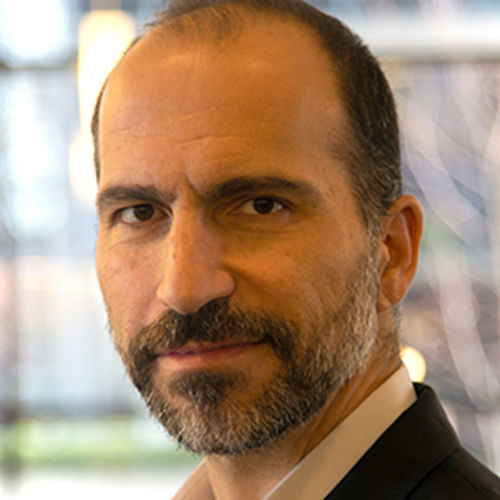
Dara Khosrowshahi
Regardless, U.S. business travelers who might have initially
hesitated to forego the traditional taxi for Uber or Lyft appear to have
established ride-hailing as the preferred method of ad hoc ground transport.
Expense-management technology company Certify said in late
July that Uber's share of second-quarter U.S. ground-transportation receipts
was 77%, about the same percentage as in the first quarter. In the same time
frame, Lyft's share rose 3 percentage points, to about 11%, while taxis' share
fell to 12% from about 14%.
Christopher Anderson, director of the Center for Hospitality
Research at the Cornell School of Hotel Administration, said Khosrowshahi has
the opportunity to widen that gap by deploying the same type of management
controls and culture he introduced at Expedia, in this case to improve driver
conditions.
"People chose Lyft at some level because it was a
little more driver-friendly, while people stuck with Uber because there was so
much demand," Anderson said. "If Dara can adjust things to make Uber
more driver-friendly, there's a huge opportunity."