MARRAKECH, Morocco -- This land of mostly desert in the
northwest corner of Africa is in the midst of a golf boom. Already, some 45
courses dot the landscape, and several more are in the works.
Even as new course openings in most of the world's golfing
countries are being outpaced by closures, the Moroccan National Tourist Office
reports that approximately 120,000 incoming tourists take to the links each
year as part of visits to the country.
But Morocco's boom is mostly unknown in the U.S., where avid
golfers overwhelmingly play in Great Britain or Ireland when they venture
outside the U.S., Mexico and the Caribbean. Last year, 371,000 Americans
visited Morocco, said Chakib Ghadouani, the tourist office's director for the
U.S. Of those, only between 5,000 and 10,000 golfed.
Beginning in 2015, the tourism ministry began pushing to
drive those numbers higher, primarily through outreach to U.S. golf tour
operators and to country clubs. It's a pitch, Ghadouani said, that requires
emphasizing Morocco not just as a golfer's paradise but also as a multidimensional
destination in which golf is one part of a broadly enriching trip.
"As an American, why would I go to Morocco to play 36 holes
per day? They can go to the Caribbean or Florida," Ghadouani said in an
interview this month at the International Golf Travel Marketplace conference,
which Morocco hosted for the first time. "Our strengths are also our culture,
our history, the food, the Moroccan way of life. This is what we mainly sell,
but for golf."
The Moroccan tourism board was just one of many destination
marketing organizations (DMOs) and golf resorts in attendance that are
searching for a way to unlock the destination golf market for U.S. travelers.
Of the estimated 60 million golfers in the world, some 24 million live in the
U.S., according to the National Golf Foundation.
But while the International Association of Golf Tour
Operators works to promote the golf destinations of members from 106 countries,
a survey unveiled by the tourism board at the event revealed that among North
Americans who traveled abroad for golf in the previous year, 41% went to Great
Britain or Ireland.
Another 21% ventured to Mexico or the Caribbean. Sixteen
percent went to Hawaii, which the researchers included as an abroad
destination. The rest of the world was left to fight over just 22% of the
market.
Association CEO Peter Walton said that the potential to
expand that market share presents a "massive opportunity" for golf destinations
throughout Europe and Asia, including Asian golf tourism leader Thailand as
well as Spain and Portugal. The two Mediterranean countries are already
destination golf locations of choice among northern European clientele.
"The reality is that Americans do travel to these places,
but they don’t go to play golf," Walton said.
Echoing Ghadouani's comments about Morocco, Walton said the
key for destinations around the world is to persuade U.S. travelers that they
can combine great golf with all of the cultural attractions that are already
drawing them to those countries.
"You explore the country by their fairways," he said.
Bill White, a golf tour operator based in southern Spain who
focuses exclusively on the inbound U.S. market, agreed.
"It's all about finding the Americans who want to travel,"
he said. "Once you have Americans who have an interest in travel, you go to a
place that is popular for golf to begin with, and then they come back for
more."
In interviews at the conference, several resorts and DMOs
said they were making new pushes or planned to develop more cohesive strategies
to lure U.S. golfers.
Japan, for example, drew more than 1.5 million visitors from
the U.S. in 2018, according to the Japan National Tourism Organization (JNTO).
But according to JNTO consultant Kieron Cashell, few Americans outside of
expats and members of the military play on any of Japan’s more than 2,000 golf
courses.
Cashell, though, sees an opening to change that, in part
because Japanese golf, which was once notoriously pricey, has gotten much
cheaper over the last decade or so, and also because only in 2018 did the JNTO
begin marketing sports tourism.
He said he hopes to use incoming traffic from the Tokyo
Olympics next summer to showcase what he says are Japan's "shockingly nice"
golf courses.
"My mission is to break that stereotype that it is
expensive, that it’s a difficult thing to do, that it’s unfriendly, that you
have to speak Japanese," Cashell said. "You don’t. It's all a myth."
Cashell also emphasized Japan's unique golfing culture,
which is marked by extraordinarily high levels of service as well as rituals
such as after-round hot baths and a sit-down meal between the front and back
nines that make it an all-day ritual.
Thailand, home to some 300 courses, also has a unique golf
culture, including its predominantly female caddie corps. But of the approximately
1 million Americans who visit there each year, only about 50,000 take to the
links, said Peeraya Tangdamrongtham, a marketing director for the Tourism
Authority of Thailand.
"We believe that American tourists have potential," she
said. "Compared to people from other countries, Americans tend to stay in very
good hotels."
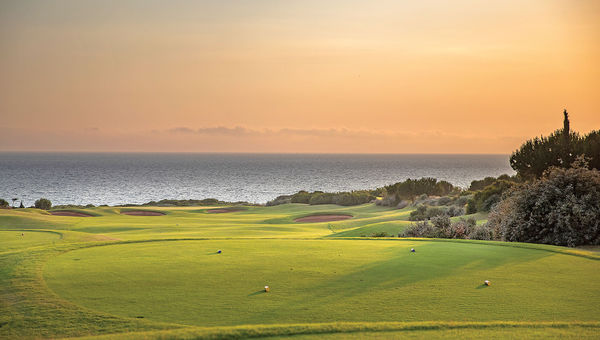
The Dunes Course at the Costa Navarino resort in Greece. Source: Costa Navarino
The tourism authority, Tangdamrongtham said, is working to
increase its U.S. market share through golf tour operator fams and through
outreach to U.S. country clubs. It always does so with a broader message about
Thailand's cultural and entertainment attractions, including Buddhist temples,
luxury hotels and great food and nightlife.
Elsewhere, strategies for reaching U.S. golfers are still
taking shape.
Ana Bastida, sport tourism brand manager for the tourism
board of Spain's Catalonia region, said that just a few weeks ago, a newly
formed organization of local resort hotels came to them requesting a targeted
campaign in the U.S. marketing Catalonia's 40 courses.
"We have next year to put together a strategy, maybe for
2021," Bastida said.
Meanwhile, at Costa Navarino, a luxury resort on Greece's
Peloponnese peninsula, the marketing team recently began a North American
campaign ahead of the planned opening of 36 new holes in 2021. To be located on
a bluff above the Ionian Sea, the two courses will augment Costa Navarino's two
acclaimed seafront courses.
"Greece is not traditionally viewed as a golf destination,"
said Maria Sverka, Costa Navarino’s sports marketing manager. "So that is what
we're trying to change. When people are actually in the destination and they
experience it, it's the aha! moment."